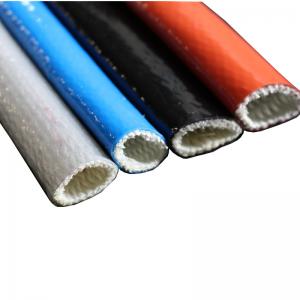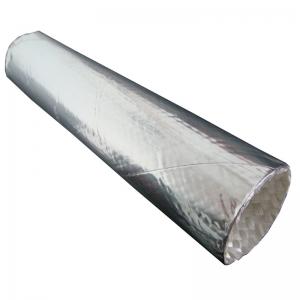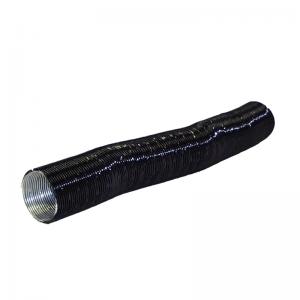
A sensor lead routed past an exhaust manifold needs more than a sleeve that looks reflective. The engineer must know where the heat comes from, how close the wire runs to it, and whether the sleeve can be installed without scraping its outer surface. For a new harness design, an aluminum silicone coated fiberglass sleeve is one tubular option to evaluate. It combines a fiberglass braid with an aluminum and silicone coated exterior; the actual thermal result depends on the completed assembly and its exposure.
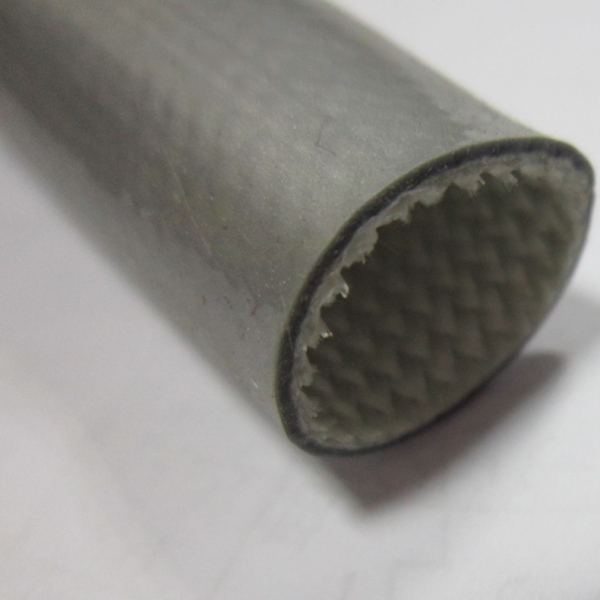
Mark the hottest sections on a drawing or photograph. Record the nearest exhaust component, the clearance to it, the length of exposure and the position of clips, branches and connectors. A sleeve that fits a straight cable on the bench may bunch at a bend or stop against a connector shoulder. Measure the harness at its widest point within the protected section, then measure every part the sleeve has to pass during assembly.
Also record whether the harness is fitted before the engine is installed. This product is a continuous tube, so it normally needs an accessible end for installation. Where a connector cannot be removed, ask about an appropriate split or wraparound construction instead of assuming this tube can open along its length.
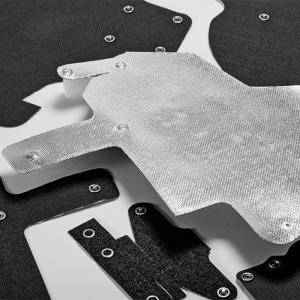
The exterior is intended to help manage radiant heat from nearby hot parts. It must face the source and remain reasonably intact. Abrasion against a bracket, repeated rubbing at a clamp, oil contamination or an excessively tight bend can change the surface condition. A sleeve does not create a fixed safe clearance, and a reflective coating does not establish the allowable temperature of the wire insulation inside it.
Separate three measurements in the evaluation: temperature of the heat source, temperature at the sleeve exterior, and temperature at the cable or sensor lead under the actual operating cycle. Idle, sustained load and heat soak after shutdown may give different results. If the assembly is in direct contact with a hot pipe, specify that contact explicitly; a radiant heat application and a contact heat application are different tests.
The aluminum silicone coated fiberglass sleeve product page lists nominal inner diameters and diameter tolerances, including small sizes for individual leads. Treat the table as the starting point for a sample request. Ask for the finished internal diameter and the applicable tolerance of the proposed size, then confirm the actual fit over the harness and any installation obstacle. Coating build and braid movement matter when a part is close to the limit of its nominal size.
For a production trial, check a cut end, a straight run, the tightest bend and the area under each retaining clip. Confirm that the sleeve does not push a branch or connector out of position. Decide whether the ends will be held mechanically, covered with an approved termination or left accessible for service. Do not assume that a generic tape or adhesive will survive the same exposure as the sleeve.
Ask for test data for the proposed finished construction when the application has a defined thermal or electrical requirement. The product name alone is not a temperature rating, and fiberglass construction alone does not prove a particular dielectric result. If electrical insulation is a safety requirement, identify the applicable test method, specimen and acceptance value before approving the sleeve.
Install the sample by the intended production method. Photograph the surface before and after pulling it over the harness, especially at connectors and bends. Inspect for exposed glass fibers, coating damage, fraying, sliding at the ends and interference with service points. Then compare protected and unprotected lead temperatures at the same locations during a representative operating cycle. Record ambient conditions and sensor placement so another engineer can reproduce the comparison.
If the route changes or the connector is redesigned, repeat the fit check. A passing result on one harness diameter or one engine layout should not be treated as approval for every variant.
Only if the connector's maximum outside dimension can pass through the selected finished sleeve without damaging it. Measure the connector, not just the cable bundle. If the available end cannot be accessed, discuss a split construction.
No. Clearance, source temperature, surface condition, air movement, contact points and the operating cycle all affect the result. Test the complete routing with temperature sensors at the protected component.
Do not infer a dielectric rating from the material description. Request test results for the specific finished size and construction against the electrical requirement of the assembly.
For a sample or quotation, send the harness drawing and exposure conditions with your required finished dimensions. Anhui Parker New Material Co., Ltd. can then review the sleeve construction and sample scope against the actual installation.

 English
 français
 Deutsch
 русский
 italiano
 español
 português
 Nederlands
 العربية
 日本語
 한국의
 Türkçe
 Polski
 Tiếng Việt
 slovenský